
We’ve all been there: You connect a modern refrigerator, Uninterruptible Power Supply (UPS), etc. to a Ground Fault Circuit Interrupter (GFCI) receptacle, only to hear the dreaded click of the GFCI tripping. You start troubleshooting and wonder if the connected load is actually faulty and why your power keeps shutting down. While it is true that loads can be faulty, causing leakage current, there is also the issue of high-frequency leakage current due to the use of switched-mode electronic power supplies in almost all modern consumer-facing electrical equipment. Examples of these are refrigerators, UPS, HVAC equipment that has variable frequency drives for energy efficiency etc.
This issue has become increasingly common as modern electrical codes—such as the 2020 and 2023 National Electrical Code (NEC)—expand GFCI requirements to more areas of the home and commercial spaces. But why exactly do electronic loads clash with GFCIs, and what can you do about it?
Below, we break down the fundamental reasons for this problem and how to resolve it.
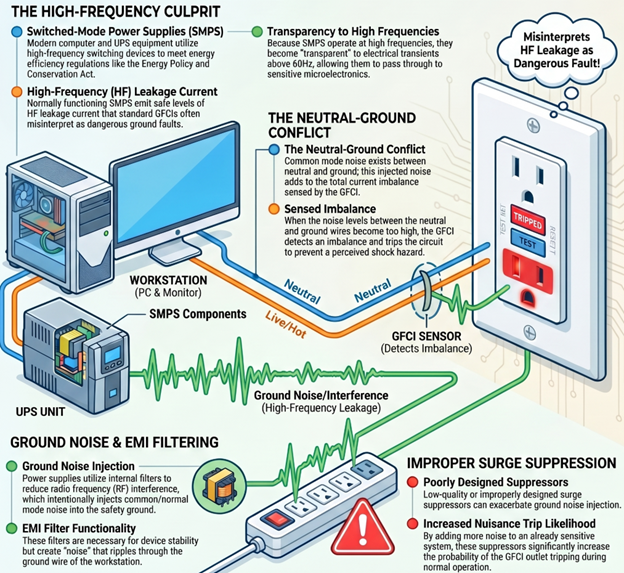
How a GFCI Works (And Why it Trips)
Before diving into the causes, it’s important to understand what a GFCI does. A GFCI is a safety device designed to protect people from severe electrical shocks by monitoring the balance of electrical current between the hot (live) and neutral conductors.
Read: Electrical resistance of human body
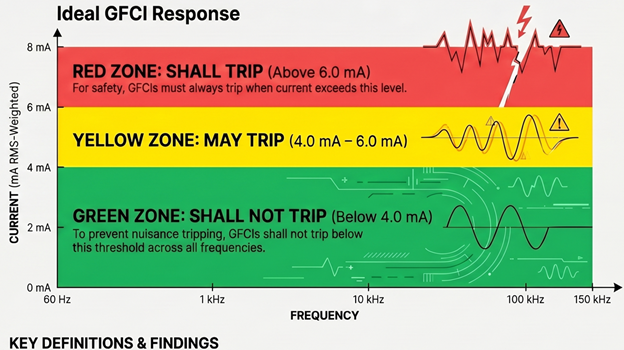
Under normal operating conditions, the current flowing “out” through the hot wire should exactly match the current coming back through the neutral wire. If the GFCI senses even a tiny mismatch, typically between 4 to 6 milliamps (mA), it assumes current is leaking elsewhere (such as through water or a human body) and immediately trips to cut power.
When newer electronic loads are plugged into a GFCI circuit, certain operational characteristics of the load can trigger this mismatch without there being a dangerous ground fault. This is known as nuisance tripping.
Read: Isolated ground receptacle
Top 4 Reasons for nuisance GFCI trip
1. Cumulative Leakage Current
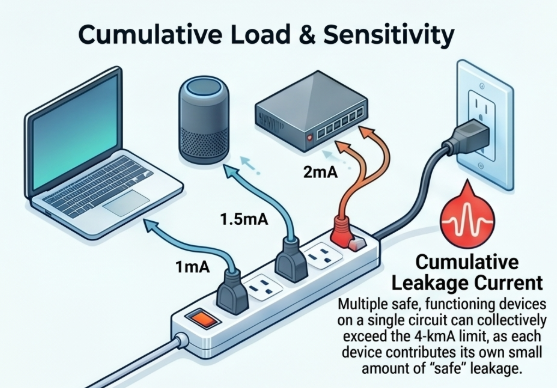
Electronic devices, especially the power supplies found in servers, computers, and IT equipment—naturally leak a tiny amount of current to the ground for safety and electromagnetic compatibility (EMC) reasons. This is called functional leakage current.
Refer to UL101 for standards pertaining to leakage current for utilization equipment.
- By design, a single appliance or computer power supply is allowed a small maximum leakage current (often around 0.5 mA to 0.75 mA).
- A power plug strip or UPS acts as a central hub for multiple pieces of IT equipment.
- When you plug the power plug strip or UPS into a GFCI-protected outlet, the cumulative leakage current of all the connected loads is sent down the same circuit.
- If this total leakage exceeds the 4–6 mA threshold of the GFCI, the breaker or outlet trips instantly.
2. Inadequate GFCI Trip Standards
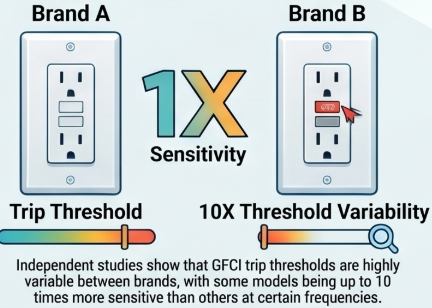
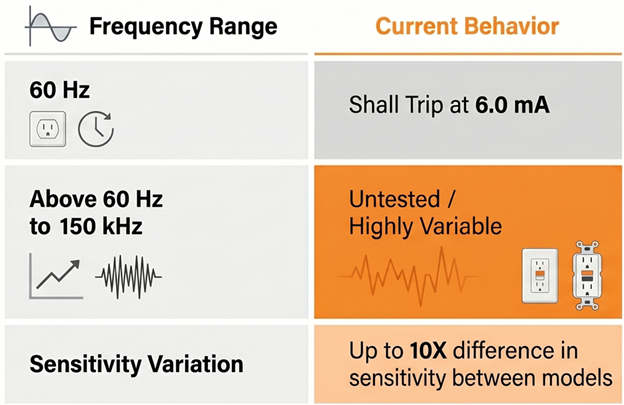
- Research conducted by UL Solutions highlights that many GFCIs on the market have highly variable trip thresholds. In testing, there was up to a 10-fold difference in trip thresholds at certain frequencies among different GFCI models.
- Because the National Electrical Code (NEC) has aggressively expanded GFCI requirements to include more household outlets and specialized high-power circuits without synchronizing with equipment safety standards, many standard GFCIs use outdated criteria.
3. Harmonic Distortion and Modern Inverters
Double-conversion (online) UPS systems convert incoming AC to DC power and then use an inverter to produce a clean, continuous AC output. Many modern electrical appliances also perform similar AC-DC power conversion (SMPS) for energy efficiency and other reasons. An unintended byproduct of this efficient AC-DC transformation is the harmonic noise and EMI/EMC issues. To filter out the harmonic noise, power supplies employ harmonic filters, surge arrestors, etc., which inject a small amount of ground leakage current.
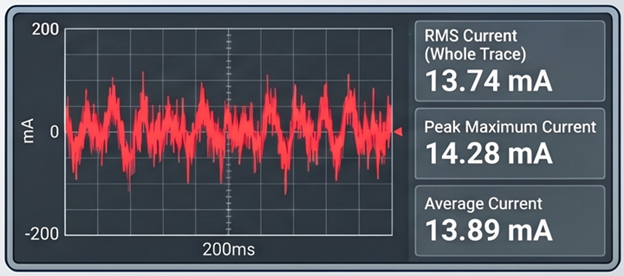
Though normal high-frequency leakage current can be completely safe for humans, GFCIs struggle to process it. Standard GFCIs were originally engineered for a world that operated strictly on 60Hz electricity. When high-frequency switching devices emit harmless background noise onto the ground line, older or overly sensitive GFCIs mis-interpret this as a standard 60Hz ground fault and trips immediately. GFCIs are typically only tested at 60 Hz, and their behavior at higher frequencies is not documented and hence could vary widely from manufacturer to manufacturer. Older or highly sensitive GFCIs are not equipped to handle these higher-frequency distortions, causing them to trip even though there is no real shock hazard present.
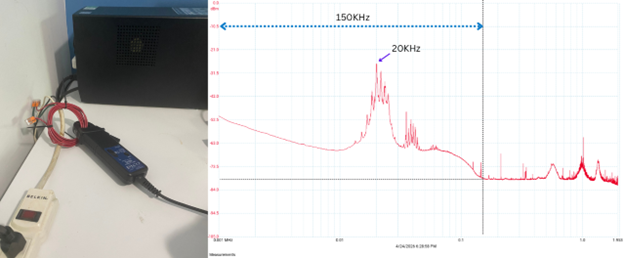
Figure 4 shows the ground current measurement and harmonic spectrum of ground current injected on the AC input side of an UPS. As can be seen, the 20 kHz frequency dominates the harmonic spectrum, which is also the frequency of the SMPS switching frequency. Most of the high-frequency components of ground current are seen to be less than 150 kHz.
Read: Ground wire vs Ground strap for high-frequency grounding
4. Shared Neutral and Pass-Through Wiring
If downstream-connected devices have a neutral-ground bond (illegal and not allowed per code) causing neutral current to also flow on the ground wire, the upstream GFCI will register this as a ground fault and trip immediately. This is considered a wiring error and should be rectified immediately.
Read: What happens when phase and neutral are reversed?
Practical Solutions to Prevent GFCI Nuisance Tripping
If your load is constantly tripping your GFCI, here are the most effective ways to troubleshoot and solve the problem assuming the load is actually not defective:
1. Reduce the Downstream Load
To address cumulative leakage, minimize the number of devices plugged into the GFCI. If the GFCI is supporting multiple servers, monitors, and networking devices, try redistributing some of these loads to separate circuits to keep the combined leakage below the trip threshold.
2. Move the GFCI Closer to the Load
If the GFCI is a circuit breaker located far away in a panelboard, the long wiring runs add natural capacitive leakage to the circuit. Consider replacing the GFCI breaker with a GFCI outlet directly at the wall where the load is plugged in. Reducing the distance reduces the baseline leakage on the circuit.
3. Use a Dedicated Circuit
Where permissible by the National Electrical Code, install a dedicated, non-GFCI branch circuit for the load. Note that you should only do this if the load is located in an area where GFCIs are not legally required (e.g., away from sinks, water sources, or damp locations).
4. Upgrade to a Newer GFCI
When GFCI was first introduced, the loads were primarily on 60 Hz. Circuitry within a GFCI was primarily intended to work with a 60 Hz current waveform. Over time, due to the proliferation of electronic switching loads (SMPS), harmonic and higher frequency current components started appearing on the phase and ground currents. Recognizing this problem, the 2026 edition of NEC introduces high-frequency (HF) rated ground fault circuit interrupters (GFCI). These GFCIs marked with “HF” are evaluated to perform satisfactorily with modern loads with advanced power conversion front ends. Examples of such loads are refrigerators, HVAC equipment, washing machines, UPS, etc. A new Class-A GFCI marked “HF” is evaluated to ensure immunity to ground currents below 4 mA across the 60 Hz to 150 kHz range.
Read: Open neutral condition
Conclusion
The intersection of expanding GFCI requirements and complex electronic loads has created a compatibility gap that often leads to annoying nuisance trips. By understanding that this is typically caused by cumulative leakage current and switching transients—rather than a true hazard—you can take the right corrective steps to ensure both safety and reliable power. Newer GFCIs that are high-frequency rated (with ‘HF’ marking) are introduced in the latest 2026 edition of NEC. An HF-rated GFCI will help alleviate the operational issues between GFCI and loads that produce high-frequency leakage currents. Some standards relevant to this topic for further reading are UL101, UL943, and UL858.
Reference 1: High-frequency ground fault circuit interrupters
Reference 2: AHAM; GFCI tripping