
Depending on source grounding, specific transformer winding, and generator connection, third harmonic (zero sequence) current may be suppressed or allowed to flow on the primary circuit. Suppressing or allowing third harmonic current can create unintentional side effects under certain conditions. Objectionable effects of such third harmonic currents are discussed in this article.
Read: Transformer connections and third harmonic components
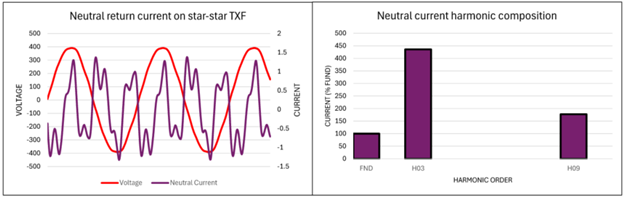
Objectionable features of third harmonic current:
- Interference to telephone or other sensitive equipment
- Increased iron loss in transformers and connected machines
- Overheating of transformer and connected machine windings
Objectionable features of third harmonic voltage:
- Possible resonance with system stray capacitance
- Increased transformer insulation stress
- Capacitive charging of adjacent lines and ELV circuits
INTERFERENCE ISSUE: Circulating harmonic current on utility lines in parallel with telephone lines can cause telephone interference. This is only relevant where the distribution lines are very long.
Read: Telephone interference factor

IRON LOSS: Increased iron loss under normal third harmonic current flow is usually not a concern for well-designed transformers, as this factor will be considered during the design process. A scenario where this could be a problem is when a generator and transformer neutrals are tied together. Depending on the generator pitch and the transformer configuration, additional generator third harmonic current can circulate through the transformer.
Read: AC Generators and winding pitch

Generators with both 2/3 pitch and 5/6 pitch generate third harmonic voltage, with 2/3 generating significantly less third harmonic when compared to 5/6 pitch units. When generators are connected in star-star (wye-wye) with their neutrals interconnected to a bank of single-phase transformers or three-phase shell-type transformers, circulating third harmonics between generator neutral and transformer neutral can lead to increased iron loss in the transformer.

Though 2/3 pitch generators generate less third harmonic voltage, they have lower zero sequence impedance compared to 5/6 pitch machines. 2/3 pitch units hence can provide a lower impedance path for zero sequence harmonics such as the third to flow. As shown in figure 4, the third harmonic excitation current from the star-connected transformer can flow through the generator windings and return through the interconnected neutral.
Read: How do power transformers saturate?
Third harmonic current circulating through neutral is usually not a problem for the generator or transformer unless the current is excessive. Some amount of circulating current always occurs when neutrals are tied together.
Read: Comparison of core and shell type transformer
RESONANCE: When banks of single-phase or three-phase shell-type transformers are connected to a network with the neutral grounded or ungrounded on the distribution side, third harmonic resonance may occur under certain conditions. Third harmonic excitation current can flow out of the windings and return through stray line-ground capacitance.
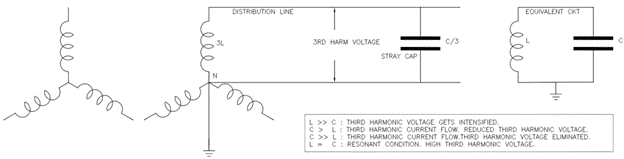
If the value of stray line capacitance is just right for resonance, third harmonic voltage can get amplified. Phase voltage can get highly distorted, and iron loss in the transformer will increase. Under the worst case, iron loss can reach up to three times the normal iron loss of a transformer.
Read: Harmonic resonance in power system
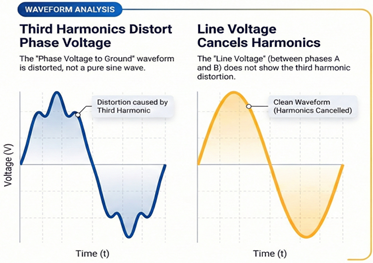
INSULATION STRESS: In a star- or wye-connected system such as an ungrounded Y-Y transformer, excitation current is suppressed. This means the core flux will have a third harmonic component, which in turn will induce a third harmonic voltage on the windings. Induced third harmonic voltage in each phase is in phase with each other, and hence, phase-to-phase third harmonic voltage will be zero. However, there will be a third harmonic voltage when measured between phase-neutral or phase-ground.
Figure 6 shows a star-star (wye-wye) transformer with primary and secondary neutrals floated (ungrounded). Line stray capacitance will be much higher than neutral-ground capacitance (since there is no fourth wire to distribute neutral). For this reason, the entire third harmonic voltage will appear across neutral capacitance (CN) and can stress the neutral insulation. This is an important consideration for graded insulation transformers, which use reduced insulation for winding near neutral.

Read: Neutral inversion and neutral displacement
Neutral point potential with respect to ground will rise and fall based on the instantaneous value of third harmonic voltage. Voltage of neutral with respect to ground will oscillate at the third harmonic frequency (150 Hz or 180Hz depending on the fundamental frequency). If an oscilloscope is connected to measure neutral-ground voltage, we would see pure third harmonic voltage. For three-phase banks comprised of single-phase transformers, this neutral third harmonic voltage can reach up to 60% of the fundamental, thereby adding stress to transformer insulation. Unbalanced loading under certain transformer configurations can also lead to third harmonic neutral-ground voltage.
CAPACITIVE CHARGING: Third harmonic voltage on lines can lead to capacitive coupling on adjacent lines, telephone lines, or other ELV circuits if the affected circuits are not properly grounded. Capacitive coupling can lead to the appearance of touch voltage and can stress the insulation of the affected circuit. In practice this is of concern only in large transmission or distribution circuits.
Read: Ground Potential Rise, Step and Touch Potential
Summary
Objectionable effects of third harmonic voltage and current are summarized in the infographic below.
