
When a power transformer is connected to an AC voltage source, a small primary current known as excitation current will flow irrespective of whether the transformer secondary is loaded or not. Excitation current is the current that is needed to magnetize the core. Apart from fundamental frequency, excitation current is predominantly composed of the third harmonic and smaller percentages of the fifth and seventh harmonics. The typical harmonic composition of excitation current as a percentage of the fundamental is 50% third harmonic current, followed by around 15% fifth and 1-2% seventh harmonic.
Origin of third harmonic voltage and current in transformer
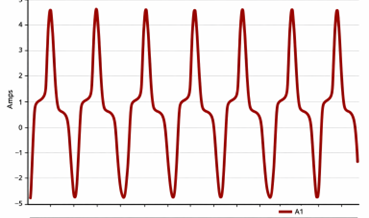
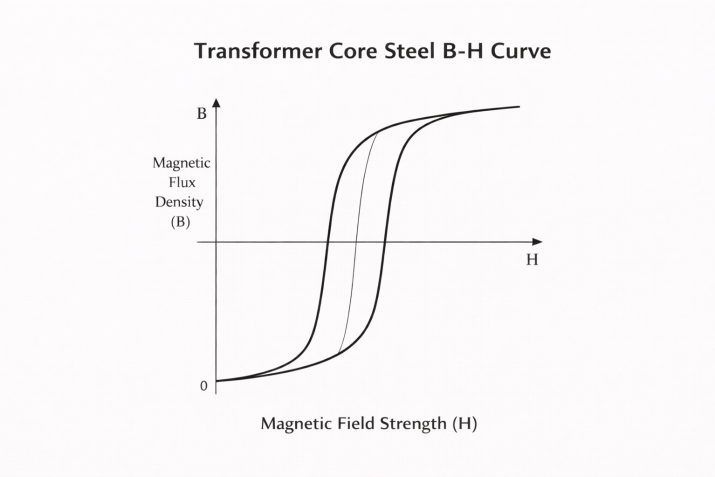
Third harmonic current is produced as a result of varying permeability of core steel to magnetizing flux. When the core construction and winding connections are such that sinusoidal flux can flow in the core, the magnetizing current will have a peculiar ‘peaky’ shape like Figure 1.
Read: Magnetic circuit for power engineers
Magnetizing current has a strong third harmonic (also small 5th and 7th) presence. The third harmonic is a zero-sequence component and has some unique properties in an interconnected transmission system. Key concepts to understand are that:
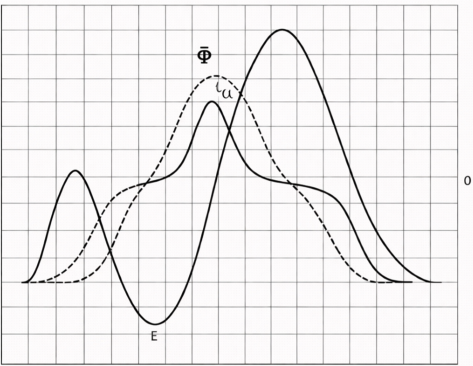
· If excitation current is free to flow in a transformer, then core flux will be sinusoidal at fundamental frequency, and excitation current will have a third harmonic component. Due to sinusoidal flux, induced voltage will be sinusoidal.
· If excitation current is ‘restricted’ to flow due to transformer winding construction or system configuration, then core flux will have a third harmonic component. The third harmonic component of core flux will introduce third harmonic voltage on the windings.
Read: Comparison of core and shell type transformer
When excitation current is restricted to flow, the magnitude of induced third harmonic phase-neutral voltage will vary. Some rough estimates are below:
- Single-phase transformers: 5-50% of fundamental
- Three-phase shell type: 5-50% of fundamental
- Three-phase 4 or 5 limb core type: 5-50% of fundamental
- Three-leg core type: 5% of fundamental
In core-type three-phase transformers with three legs (limbs), the reluctance to the flow of third harmonic flux is high such that even if the excitation current is suppressed, the third harmonic voltage will be low for such units.
Read: Zero sequence impedance of core and shell type transformers
Single-phase core and shell-type as well as three-phase shell and 4- or 5-limb core-type transformers can have appreciable third harmonic voltage on account of the closed path for third harmonic flux to circulate in the core.
Read: Advantages of triplex transformer
Another interesting point is that due to the zero-sequence nature of the third harmonic, only third harmonic phase-neutral will be present and not third harmonic phase-phase voltage. If an oscilloscope is connected to measure neutral-ground voltage, we would see pure third harmonic voltage. Any loads connected to phase-neutral will experience effects of third harmonic voltage riding on top of fundamental voltage, which results in a ‘peaked’ voltage waveform.
Delta winding on the transformer provides a closed path for circulation of third harmonic excitation current within the closed delta. No third harmonic current will flow on the lines, and no third harmonic phase-neutral voltage will exist on the secondary star (wye).
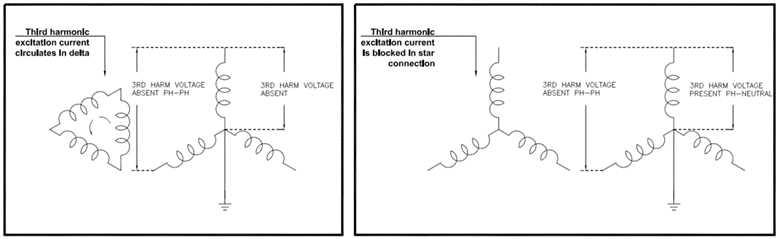
A star-star (wye-wye) transformer will not have a path for third harmonic excitation current. Third harmonic voltage will appear between phase and neutral. See figure 4.
Read: Transformer connections: Phase shift and polarity
In short, for a given transformer connection, the third harmonic must be present either in the excitation current or in the phase-neutral voltage. The figure below shows the effect of transformer connection on third harmonic currents for a grounded source.
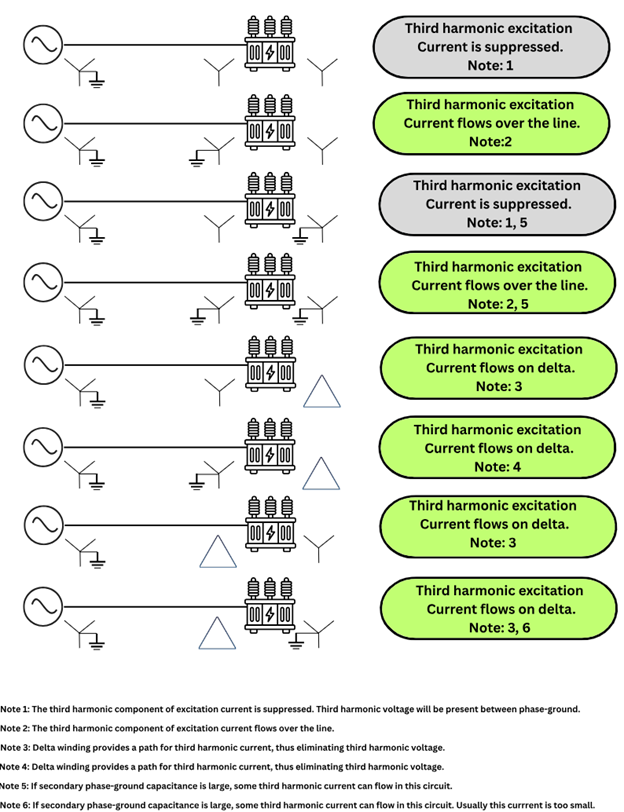
It is seen that the presence of at least one delta winding will invariably result in a third harmonic excitation current circulating within the delta, thus preventing the third harmonic current from circulating on utility lines.
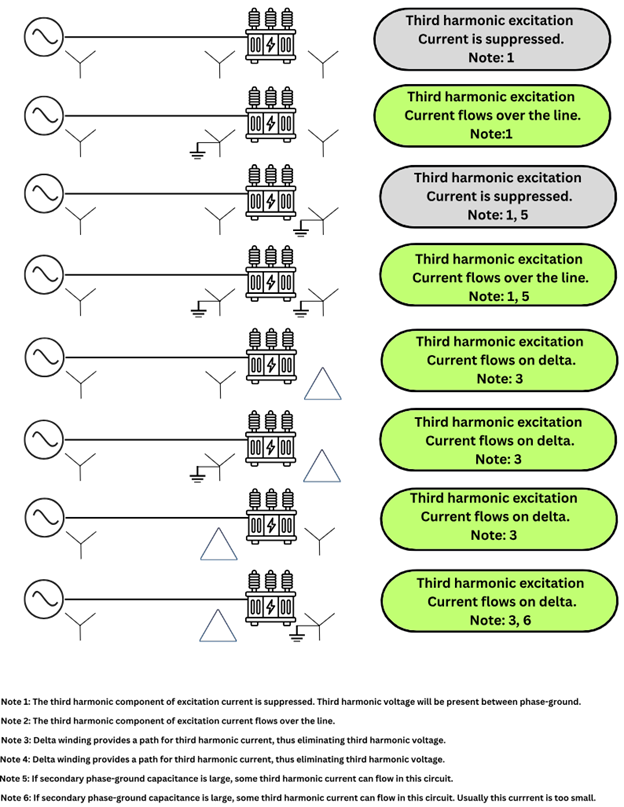
The figure below shows the effect of transformer connection on third harmonic currents for an ungrounded source.
Read: Delta and Wye connection
Summary
For a three-phase power transformer, the following may be summarized:
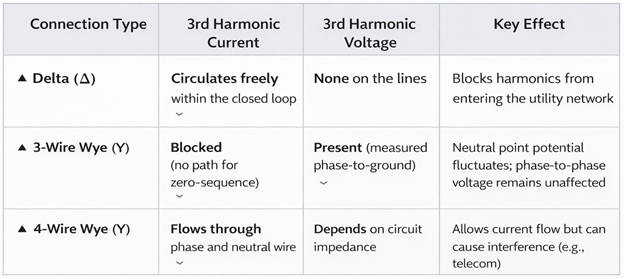
- Delta connection permits free flow of third harmonic excitation current within the closed delta. No third harmonic current will flow on the lines, and there is no third harmonic phase-neutral voltage on the star (wye)-connected winding. The presence of a delta winding either on the primary or secondary will help with containing the third harmonic excitation current.
- For a three-wire wye (star) connection, third harmonic current flow is blocked. This is due to the nature of the third harmonic, which is a zero-sequence component. Zero sequence current will have the same phase angle and flow in the same direction. Without a fourth neutral wire, zero-sequence third harmonic current cannot flow in an ungrounded star-connected transformer.
- For a three-wire wye (star) connection, third harmonic voltage may or may not exist depending on the impedance of the third harmonic circuit of the associated circuit. For example, if there is one delta winding in the transformer, there won’t be a third harmonic voltage between phase-ground on the star (wye) side of the transformer.
- For a four-wire wye (star) connection, third harmonic current may flow through the phase and fourth wire.
- For a four-wire wye (star) connection, third harmonic voltage may or may not exist depending on the third harmonic impedance of the associated circuit.